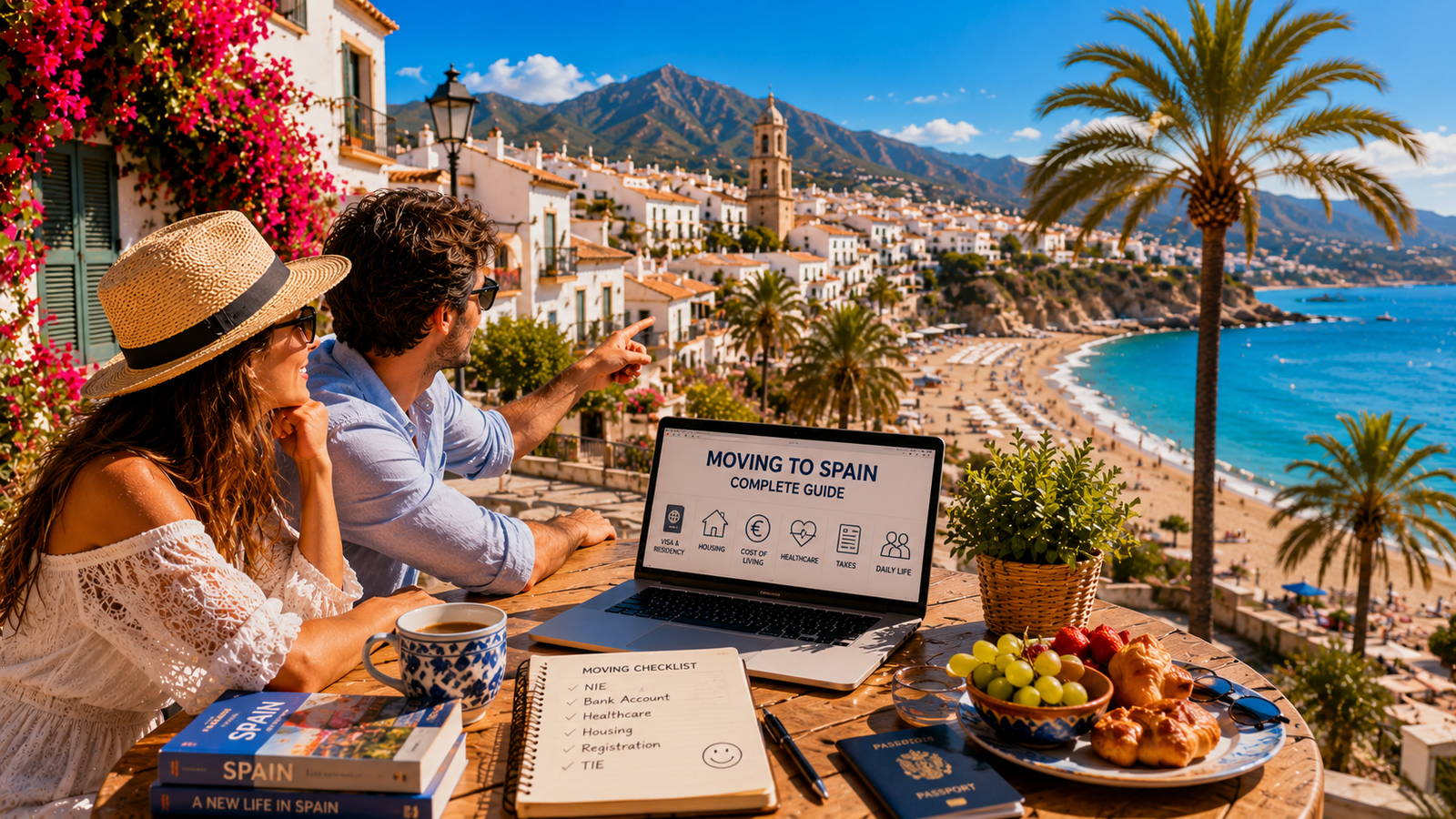
Moving to Spain: Complete Guide for Foreigners
Moving to Spain is one of the biggest lifestyle decisions many foreigners make. Some people move for sunshine and retirement. Others move for family life, remote work, lower stress, better weather, healthcare, property investment or a new personal chapter.
Spain can be an excellent country to live in, but it is not a place where you should arrive without a plan. You need to understand visas, residence cards, housing, healthcare, schools, banking, taxes, transport, language and the real cost of living.
After living in Spain for around ten years, first in Valencia and later on the Costa del Sol, working in Torremolinos, becoming self-employed and raising three children here, my view is simple: Spain rewards people who prepare properly. The lifestyle can be incredible, but bureaucracy, housing pressure and regional differences can surprise foreigners.
Before moving, start with the practical relocation and travel information on SpainCheck.com, then compare the real cost of living in Spain and the best places to live in Spain.
Most important rule: Do not move to Spain based only on holiday feelings. Test the area in real life, calculate your monthly budget, check school and healthcare access, understand your visa route and decide whether you want city life, coastal life, family suburbs, retirement areas or a local Spanish town.
💶 Check Your Take-Home Pay in Spain
Estimate your take-home pay and better understand how much of your gross salary you could receive after deductions.
🚨 Emergency Numbers in Spain
Find emergency numbers and official resources for healthcare, police, taxes, traffic, property records and public services.
Moving to Spain: Step-by-Step Overview
Watch: Moving to Spain in 2026
This video gives a practical visual overview of what foreigners should know before moving to Spain in 2026, including lifestyle, planning, paperwork and daily realities.
Moving to Spain is easier when you separate the process into clear steps. The order may change depending on whether you are an EU citizen, UK citizen, American, retiree, digital nomad, worker, student or property buyer.
| Step | What to Do | Why It Matters |
|---|---|---|
| 1. Choose your visa or residency route | Check whether you need a visa, residence permit, EU registration or TIE. | Your legal route affects healthcare, work rights, taxes and documentation. |
| 2. Choose your region | Compare Madrid, Barcelona, Valencia, Málaga, Costa del Sol, Alicante, islands and inland Spain. | Weather, housing, schools, transport and lifestyle vary strongly by area. |
| 3. Build your budget | Include rent, utilities, healthcare, transport, schools, taxes and moving costs. | Spain is not one price market. Costs differ hugely by city and lifestyle. |
| 4. Find temporary housing first | Use short-term rental or temporary accommodation before committing long term. | You need to test neighbourhoods before signing a long rental or buying. |
| 5. Arrange documents | Prepare passport, birth/marriage certificates, bank statements, insurance, criminal record checks if needed and translations. | Spanish administration often requires originals, copies, apostilles and sworn translations. |
| 6. Register locally | Get empadronamiento, NIE/TIE or EU registration depending on your case. | Local registration is often needed for healthcare, schools and other services. |
| 7. Build your daily life | Set up bank account, phone, internet, school, doctor, transport and local support. | The move becomes real when daily systems work smoothly. |
Do You Need a Visa to Move to Spain?
Whether you need a visa depends mainly on your nationality, how long you want to stay and whether you plan to work, study, retire, invest or live from foreign income.
EU, EEA and Swiss citizens have a simpler route because they have freedom of movement rights, although they still need to register if they stay long term. Non-EU citizens usually need a visa or residence authorization before moving permanently.
Spain’s Ministry of Foreign Affairs provides official information through Spanish consulates, including national visa guidance. Always check the Spanish consulate responsible for your country before making decisions.
Common visa and residency routes
| Route | Best For | Important Notes |
|---|---|---|
| EU citizen registration | EU, EEA and Swiss citizens staying long term | You usually need to show identity, financial means, work/self-employment or healthcare coverage. |
| Non-lucrative visa | Retirees and people with passive income | Usually does not allow work in Spain. Private health insurance and financial proof are important. |
| Digital nomad visa | Remote workers and foreign-company contractors | Designed for people working remotely for non-Spanish companies or clients, subject to conditions. |
| Work visa | People hired by a Spanish employer | Normally requires job sponsorship and authorization. |
| Self-employed visa | Entrepreneurs and autónomos | Requires business planning, financial proof and administrative preparation. |
| Student visa | Students and language learners | Useful for study, but work rights and long-term transition rules must be checked. |
| Family reunification | Family members of eligible residents | Depends on the sponsor’s status, income and legal residence. |
Important: Visa rules change and depend on nationality. Use official Spanish consulate information first, then speak with a qualified immigration lawyer if your situation is complex.
NIE, TIE and Empadronamiento Explained
Foreigners moving to Spain quickly hear three words: NIE, TIE and empadronamiento. They are not the same thing, but they are all important.
NIE
The NIE is the foreigner identification number. You may need it for property, tax, banking, contracts, employment, self-employment and many administrative steps.
TIE
The TIE is the Foreigner Identity Card. It is a physical card used by many non-EU residents to prove legal residence status in Spain.
Empadronamiento
Empadronamiento means registering your address with the local town hall. It helps prove where you live and is often needed for schools, healthcare, residency processes and local services.
🧾 NIE
Your foreigner identification number for tax, legal and administrative use.
💳 TIE
Your physical foreigner identity card if your residence route requires one.
🏛 Padrón
Your municipal registration proving where you live in Spain.
Choosing Where to Live in Spain
Your location will shape your entire experience. Spain is very regional. Madrid, Barcelona, Valencia, Málaga, Marbella, Alicante, Seville, Bilbao, Palma and the Canary Islands all offer different versions of Spanish life.
Families should think about schools and daily routes. Retirees should think about healthcare, walkability and winter life. Remote workers should think about internet, airport access and year-round community. Property buyers should think about long-term value, taxes and legal checks.
For a wider comparison, read Best Places to Live in Spain for Expats.
| Area | Best For | Main Advantage | Main Caution |
|---|---|---|---|
| Madrid | Jobs, business, culture | Capital city, strong economy, transport, schools | Higher rent, traffic, hot summers |
| Barcelona | International lifestyle, tech, culture | Beach-city mix, networking, creative economy | Expensive housing and tourism pressure |
| Valencia | Families and remote workers | Balanced cost, beach, parks, food and city services | Rising popularity and summer humidity |
| Málaga | Remote workers, families, airport access | Climate, culture, beach, transport and Costa del Sol access | Housing demand rising quickly |
| Costa del Sol | Retirees, families, property buyers | Weather, international schools, healthcare, golf, beaches | Summer traffic and higher prices in prime areas |
| Alicante / Costa Blanca | Retirees and value-focused expats | Good climate, airport and more affordable coastal options | Some areas feel seasonal |
| Canary Islands | Year-round mild weather and remote work | Climate, nature and outdoor lifestyle | Island logistics and distance from mainland Europe |
Housing: Rent First or Buy First?
For most foreigners, renting first is safer. Spain looks different when you live there than when you visit for a holiday. A neighbourhood can feel perfect in May and too busy in August. A coastal apartment can be beautiful but noisy. A cheap inland home can be peaceful but inconvenient without a car.
When comparing long-term housing options, it is also worth understanding how newer residential communities work in practice. Many people moving to Spain are attracted by modern homes, swimming pools, gyms, coworking spaces, landscaped gardens and secure communal areas. Before deciding if this type of property fits your relocation plans, read about living in a modern new development in Spain.
If you are moving to the Costa del Sol and considering buying, use Costa Prime Realty for property search, area guidance, legal coordination and buyer support.
For apartment-focused research, compare apartments on the Costa del Sol. For modern new-build projects, see new developments on the Costa del Sol.
Buying property in Marbella, Sotogrande or the Costa del Sol
Marbella and Sotogrande are very different markets from a normal city rental search. Marbella is more international, luxury-focused and lifestyle-driven. Sotogrande is more private, golf, marina and villa-oriented.
If Marbella is your target, use Homes Marbella for local property and area information. If you are comparing Sotogrande, review Property Sotogrande.
If you are looking for larger homes, villas or long-term luxury living, compare villas for sale in Spain and supporting property insights on Villa for Sale Spain Blog.
Cost of Moving to Spain
The cost of moving to Spain depends on your household size, visa route, country of origin, shipping needs, temporary housing, property choice and whether you rent or buy.
Do not calculate only flights and rent. Include legal documents, translations, apostilles, insurance, deposits, agency fees, furniture, school costs, car costs, health insurance and emergency savings.
| Moving Cost | Typical Range | Notes |
|---|---|---|
| Flights and initial travel | Varies widely | Depends on origin country, family size and baggage. |
| Temporary accommodation | €1,000–€4,000+ | First month or two can be expensive in popular areas. |
| Rental deposit | 1–3 months of rent | Landlords may ask for proof of income or extra guarantees. |
| Visa/legal documents | Varies | May include fees, translations, apostilles, lawyers and certificates. |
| Health insurance | Often €50–€200+ per person/month | Depends on age, coverage and visa requirements. |
| Furniture and setup | €1,000–€8,000+ | Depends on whether the home is furnished. |
| Car and transport setup | €500–€10,000+ | Depends on whether you buy, import or lease a car. |
For realistic monthly budgets, read the full Cost of Living in Spain 2026 guide before choosing your city.
Healthcare When Moving to Spain
Healthcare is one of the most important parts of moving to Spain. Spain has a strong public healthcare system, but access depends on your status: employed, self-employed, pensioner, EU resident, non-EU resident, student, private insured person or family member.
The Spanish Ministry of Health is the official source for healthcare information. Some foreigners also use private insurance, especially during the first stage of relocation or when required for a visa.
Public healthcare
Public healthcare access is often connected to social security contributions, employment, self-employment, pension rights or qualifying residence routes. The practical steps can vary by region.
Private healthcare
Private healthcare is common among foreigners because it can offer faster appointments, English-speaking doctors and easier access during the transition period.
Special healthcare agreement
Spain also has a special healthcare agreement route in some situations. The Ministry of Health explains that applicants may need effective residence, municipal registration and identification documents.
Healthcare is one reason many people choose Spain for long-term life and retirement. Read more about the quality of life in Spain and life expectancy in Spain.
Banking and Money Setup
A Spanish bank account can be useful for rent, utilities, taxes, salaries, school payments, insurance and property purchases. Some banks offer non-resident accounts, while others require more documentation.
Common documents may include passport, NIE, proof of address, proof of income, tax identification information and residency documents. Requirements vary by bank.
🏦 Bank Account
Useful for rent, utilities, salaries, taxes, insurance and daily payments.
💶 Currency Planning
If your income is not in euros, exchange rates can affect your real budget.
📄 Tax Position
Tax residence can change your obligations. Plan before you move, not after.
Taxes When Moving to Spain
Taxes are one of the most important areas to understand before moving. Your tax position can change depending on how many days you spend in Spain, where your income comes from, whether you work, own property, receive a pension or become self-employed.
Property buyers should especially review Spain Property Tax before buying, because purchase taxes, ownership costs, non-resident tax and capital gains rules can affect the real cost of living.
Tax warning: Do not assume your tax situation stays the same after moving to Spain. Speak with a qualified tax adviser before relocating, especially if you have foreign income, property, pensions, investments or business income.
Schools and Moving with Children
Moving to Spain with children requires more planning than moving alone. You need to think about schools, language, transport, healthcare, after-school activities, sports, friends and long-term integration.
As a father of three living on the Costa del Sol, I would say school choice is one of the biggest decisions. It affects where you live, your morning routine, your social circle, your budget and your children’s language development.
| School Type | Best For | Main Consideration |
|---|---|---|
| Public school | Integration and Spanish language | Good for local life, but children may need language support. |
| Concertado school | Semi-private structure | Lower cost than private, but availability varies. |
| Private Spanish school | Families wanting structured private education | Costs, language and curriculum should be checked. |
| International school | Foreign families and smoother academic transition | Can be expensive and may influence where you live. |
Families often choose areas such as Valencia, Madrid suburbs, Barcelona suburbs, Málaga, Benalmádena, Fuengirola, Marbella, Estepona and Alicante because of schools, healthcare and international communities.
Working in Spain
Working in Spain can mean very different things. You might work for a Spanish employer, run your own business, work remotely for a foreign company, become self-employed, study first or retire without working.
Local salaries in Spain can be lower than in Northern Europe or the United States, especially outside major cities. This is why many foreigners move with remote income, pensions, savings or international clients.
If your move depends on work, read our guide to Spain work-life balance before deciding. Spain offers lifestyle advantages, but administration, autónomo costs and local salary levels must be understood.
Moving to Spain as a Retiree
Spain is one of the most attractive countries in Europe for retirement because of climate, healthcare, food, social life, safety and outdoor living.
Retirees should focus on healthcare access, walkability, airport connections, winter activity, language comfort, local community, property costs and long-term care planning.
The Costa del Sol, Costa Blanca, Valencia region, Canary Islands and Mallorca are popular retirement choices, but the best place depends on budget and lifestyle.
Read the full guide to retiring in Spain before making a final decision.
Moving to Spain from the United States
Americans moving to Spain often focus on healthcare, lower stress, walkability, safety, climate and European culture. The biggest differences are usually visa planning, tax planning, banking, healthcare access and the slower rhythm of Spanish administration.
Madrid, Barcelona, Valencia, Málaga, the Costa del Sol and Alicante are common choices because they offer international airports, services, lifestyle and communities where foreigners can adapt more easily.
Read the dedicated guide: Living in Spain as an American.
Moving to the Costa del Sol
The Costa del Sol is one of the strongest lifestyle regions in Spain for foreigners. It offers sunshine, beaches, mountains, golf, international schools, healthcare, Málaga Airport, sports facilities and a large international community.
But the Costa del Sol is not one place. Málaga city, Torremolinos, Benalmádena, Fuengirola, Mijas, Marbella, Estepona, Casares, Manilva and Sotogrande all have different prices, traffic, schools, property types and lifestyle.
For real estate help, start with Costa Prime Realty. For Marbella-specific research, use Homes Marbella. For Sotogrande, compare Property Sotogrande.
🌊 Beach Lifestyle
Ideal for people who want sea, promenades, cafés, sports and outdoor living.
🏫 Schools
International and private school access makes the region popular with families.
✈️ Airport Access
Málaga Airport is a major advantage for international families, retirees and business owners.
Before You Move: 90-Day Checklist
| Time Before Move | What to Do | Why |
|---|---|---|
| 90 days before | Confirm visa route, budget, destination shortlist and document requirements. | Some documents take weeks or months to prepare. |
| 60 days before | Book temporary accommodation, compare schools, arrange insurance and prepare funds. | You need a safe arrival plan before signing long-term contracts. |
| 30 days before | Prepare copies, translations, appointments, moving logistics and local contacts. | Spanish administration often requires paper documents and appointments. |
| Arrival week | Get SIM card, settle housing, register locally, open bank account if possible and learn your area. | The first week should focus on practical stability. |
| First 90 days | Complete TIE/EU registration, healthcare steps, school setup, tax planning and long-term housing search. | This is when your move becomes legally and practically stable. |
Common Mistakes Foreigners Make
Smart Moves
- Visit the area outside holiday season.
- Rent before buying.
- Prepare visa documents early.
- Check school and healthcare access first.
- Budget for taxes, insurance and transport.
- Learn basic Spanish before arriving.
Costly Mistakes
- Choosing a home only because it has a sea view.
- Ignoring summer traffic and parking.
- Underestimating bureaucracy.
- Forgetting property purchase taxes.
- Assuming English is enough everywhere.
- Moving without emergency savings.
Frequently Asked Questions
Is moving to Spain easy?
Moving to Spain can be straightforward if you prepare correctly, but it is not always fast. The easiest moves are usually made by people who understand their visa route, budget, healthcare access and housing plan before arriving.
How much money do I need to move to Spain?
It depends on your household size and destination. A single person should usually have several months of living costs saved. Families and property buyers need much more because housing, schools, deposits, insurance and setup costs are higher.
Can I move to Spain without a job?
Some people can move without a Spanish job if they qualify for a non-working visa, retirement route, student visa, digital nomad route or have sufficient financial means. The correct option depends on nationality and personal situation.
Should I rent or buy first in Spain?
Most foreigners should rent first unless they already know the area very well. Renting lets you test daily life, traffic, noise, schools, shops and the neighbourhood before buying.
Is Spain good for families?
Yes, Spain can be excellent for families. Children are welcome in public life, outdoor activities are strong, and many regions offer good schools, healthcare and sports. School choice should be planned early.
Where should foreigners move in Spain?
Popular choices include Madrid, Barcelona, Valencia, Málaga, the Costa del Sol, Alicante, the Canary Islands and Mallorca. The best choice depends on work, budget, schools, weather and lifestyle.
Final Thoughts
Moving to Spain can be one of the best decisions of your life, but only if you prepare properly.
Spain offers sunshine, healthcare, food, culture, family life, beaches, mountains, history and a better outdoor lifestyle than many countries. But it also requires patience, paperwork, realistic budgeting and respect for local systems.
The best move is not the fastest move. Visit first, compare regions, prepare documents, rent before buying, understand taxes and build a daily life that works beyond the holiday feeling.
Useful Spain Relocation and Property Resources
Use these websites to compare lifestyle, relocation, property, taxes and area decisions before moving.
Continue Reading About Life in Spain
Useful Official Sources
- Spanish Ministry of Foreign Affairs — official consular and visa information.
- Ministry of Inclusion, Social Security and Migration — official social security and migration information.
- Spanish Ministry of Health — official healthcare information.
- INE Spain — official population, demographic and economic statistics.
- AEMET — official Spanish weather forecasts, climate data and warnings.
- Spain.info — official tourism information about Spanish cities, food, culture, beaches and nature.
This article is for general information only. Visa, tax, healthcare and residency rules depend on nationality and personal situation. Always check official sources and speak with qualified legal, tax, immigration, healthcare or property professionals before making decisions.